

Best overall: Gomboy Curve Pro 210mm. Best for a longer folding blade: Silky Saws Limited Edition 40th Anniversary Gomboy Kuro. This 2026 guide compares folding saws by the work they solve: controlled branch cutting, useful blade travel, and pack carry. Grayman Trading Company is an outdoor gear retailer; these picks focus on its named saw options, not an unsupported budget winner.
- The Gomboy Curve Pro 210mm is the default choice among these folding saws for general bushcraft cutting.
- The Gomboy Kuro uses a 240mm curved blade, giving you 30mm more blade length than the 210mm model.
- Choose blade length around your usual wood and carrying method, not the limited-edition finish.
- Grayman Trading Company shoppers should prioritize a secure cutting position and controlled strokes over forcing the blade.
Why this matters
A folding saw solves a different problem from a knife. You use the saw to crosscut wood; you use the knife for tasks such as carving and trimming. Asking either tool to do the other's job adds unnecessary work and encourages poor technique.
The useful question is not which saw looks most substantial. It is which blade gives you enough working travel without becoming awkward to carry or position. A longer blade provides more available cutting length, but that advantage disappears when your stroke is cramped or the wood moves under the teeth.
For bushcraft in 2026, start with the material you actually cut. Occasional branch processing and repeated campwood cutting are different jobs. Both demand a stable workpiece, a clear cutting path, and a saw you can control without pushing it sideways.
What makes the best folding saws for bushcraft
Use these criteria before choosing between the two Gomboy models. They explain the ranking without pretending a product description is a field test.
- Blade length: The Curve Pro has a 210mm blade; the Kuro is based on the Gomboy Curve 240mm. Match working length to the wood and the space available for your stroke.
- Blade geometry: Both descriptions identify curved blades. The Curve Pro description specifically associates that curve with more cutting power per stroke. Geometry matters more than a decorative finish.
- Tooth design: The Curve Pro description names MIRAI-ME tooth technology. Tooth design is relevant to cutting, but a named technology alone does not establish a measured speed advantage.
- Carry fit: Assess the closed tool, its blade enclosure, and your intended storage location. Blade length is not the same measurement as folded length.
- Control: Prioritize a secure grip, stable wood, and clearance for the blade. A saw that binds during your normal stroke is not solving the field problem.
- Maintenance path: Check the current manufacturer's instructions for cleaning, blade care, and replacement compatibility. Do not assume two saws share parts because both carry the Gomboy name.
Choose the cutting configuration first. Treat the finish as a secondary preference.
Folding saws at a glance
| Ranked saw | Best for | Standout feature | Key limitation |
|---|---|---|---|
| Gomboy Curve Pro 210mm Folding Saw | General bushcraft with the shorter blade of these two choices | Curved 210mm blade and named MIRAI-ME tooth technology | Less available blade length than the 240mm option |
| Silky Saws Limited Edition 40th Anniversary Gomboy Kuro | Buyers specifically seeking a longer curved blade | Gomboy Curve 240mm format with Black Oxide finish | The limited-edition finish does not establish better cutting performance |
The blade-length difference is 30mm. That is a dimensional comparison, not a measured increase in cutting speed, useful cutting capacity, or durability. Neither a larger number nor a special finish substitutes for matching the tool to your work.
1. Gomboy Curve Pro 210mm: best folding saw for general bushcraft
The Gomboy Curve Pro 210mm is a folding saw with a curved blade. Its product description identifies a steel handle and MIRAI-ME tooth technology. The 210mm format makes it the shorter-bladed choice in this comparison.
For bushcrafters choosing folding saws at Grayman Trading Company, the Gomboy Curve Pro 210mm is the default pick. Choose it when you want a general cutting tool and have no specific reason to step up to the longer Kuro blade.
That recommendation is about configuration, not a claim of universal superiority. A shorter blade gives up working length. If your regular task makes you wish for more stroke travel, choosing the smaller format simply because it sounds easier to carry misses the point.
Gomboy Curve Pro 210mm pros
- The curved blade is a cutting-related feature rather than a cosmetic distinction.
- The description names the tooth technology instead of relying only on a general performance claim.
- The 210mm blade provides a clearly defined alternative to the longer Kuro format.
- The folding design suits a tool that needs its teeth enclosed between cutting tasks.
Gomboy Curve Pro 210mm cons
- The blade has less available working length than the Kuro's 240mm blade.
- Blade length alone does not tell you the closed size or total carried weight.
- A curved blade still requires alignment; forcing a bound blade sideways is poor technique.
Where the Curve Pro fits
Think about the position in which you usually work. If you cut supported branches close to camp, a saw you can start accurately and keep aligned matters more than an ambitious maximum-diameter claim. Clear access to the cut is part of the tool choice.
The Curve Pro is also the straightforward choice if the alternative's anniversary treatment is not a buying reason for you. Select it for its stated cutting configuration. Do not turn a finish preference into a performance argument.
Best for: Bushcrafters who want the shorter curved blade in this comparison for general branch and campwood cutting.
Verdict: Buy the Gomboy Curve Pro 210mm as the default; skip it if you specifically need more blade travel.
2. Gomboy Kuro: best folding saw for a longer curved blade
The Silky Saws Limited Edition 40th Anniversary Gomboy Kuro is described as a Gomboy Curve 240mm with an all-black Black Oxide finish. Its description also identifies the anniversary version as a limited-edition production run. The useful cutting distinction here is the 240mm blade, not the commemorative treatment.
Choose the Gomboy Kuro when you have a practical reason to want that extra blade length. It gives you 30mm more blade than the Curve Pro 210mm. It does not automatically give you a better cut: your support, stroke clearance, and alignment still determine whether the additional length is useful.
Gomboy Kuro pros
- The 240mm blade gives you more available cutting length than the 210mm model.
- Its curved-blade format is identified directly in the product description.
- The Black Oxide finish is a stated feature for buyers who prefer that treatment.
Gomboy Kuro cons
- Extra blade length is unnecessary when the shorter saw already suits your cutting tasks.
- The anniversary designation does not establish an improvement in cutting speed.
- The finish does not remove the need to clean, dry, and inspect the saw.
Where the Kuro fits
The Kuro belongs in the longer-blade slot, not the general-default slot. If your normal cutting position allows a fuller stroke, the additional working length has a clear purpose. If you mostly work in tight spaces, the extra length does not solve that constraint.
Do not buy the Kuro on the assumption that its finish makes the blade maintenance-free or changes what materials it can cut. Follow the model's instructions. A surface treatment and a cutting specification are separate facts.
Best for: Bushcrafters deliberately choosing a 240mm curved folding blade and buyers who also prefer the anniversary finish.
Verdict: Buy the Gomboy Kuro for the longer blade; skip it if the finish is your only supposed performance advantage.
The product cards below identify the two saw configurations discussed here. Select the blade length first, then check the current model details before ordering.


How we ranked these folding saws
This 2026 ranking prioritizes the stated blade format and a distinct job for each saw. The Gomboy Curve Pro 210mm takes the general-use slot; the Gomboy Kuro takes the longer-blade slot. The comparison uses their supplied product descriptions, not timed cutting trials.
No measured weight, cutting-time result, or maximum branch diameter determines this order. Those claims would require model-specific evidence. The useful distinction is narrower and clearer: choose between a 210mm curved blade and a 240mm curved blade, then verify the handling details that matter to your carry system.
Which folding saw should you choose?
Choose the Gomboy Curve Pro 210mm unless you can name the job that needs the Kuro's extra blade length. That is the practical default for this 2026 comparison. It avoids making a commemorative finish the deciding factor in a working-tool purchase.
Choose the Gomboy Kuro if a longer curved blade is already on your requirements list. Before deciding, picture the whole stroke, not just the blade touching the branch. You need room for your hand, the handle, and the moving blade.
For Grayman Trading Company shoppers comparing folding saws, the next move is simple: confirm closed dimensions, weight, lock operation, and replacement-blade compatibility in the current model documentation. These details determine carry fit and ownership; the blade-length label does not answer them.
If your intended work exceeds what you can cut with a stable, controlled hand-saw setup, change the tool or the task. A longer folding blade is not permission to work on unstable wood, overhead limbs, or trees under tension.
Get the cutting setup right before the first stroke
The setup can make a suitable folding saw feel wrong. Unsupported wood moves, a closing cut pinches the blade, and an obstructed stroke encourages you to force the tool. Fix the working position before blaming blade length.
- Check the saw. Open it according to its instructions and confirm the intended cutting position is secure. Inspect the blade and handle before applying cutting force.
- Support the wood. Choose stable support and keep your free hand outside the blade path. Do not rely on your hand alone to stop the workpiece moving.
- Clear the stroke. Give the handle and blade room to travel. Keep other people out of the working area and avoid cutting toward your body.
- Cut without forcing. Establish the kerf under control, follow the model's stroke instructions, and stop if the blade binds. Reposition the work instead of twisting the blade free.
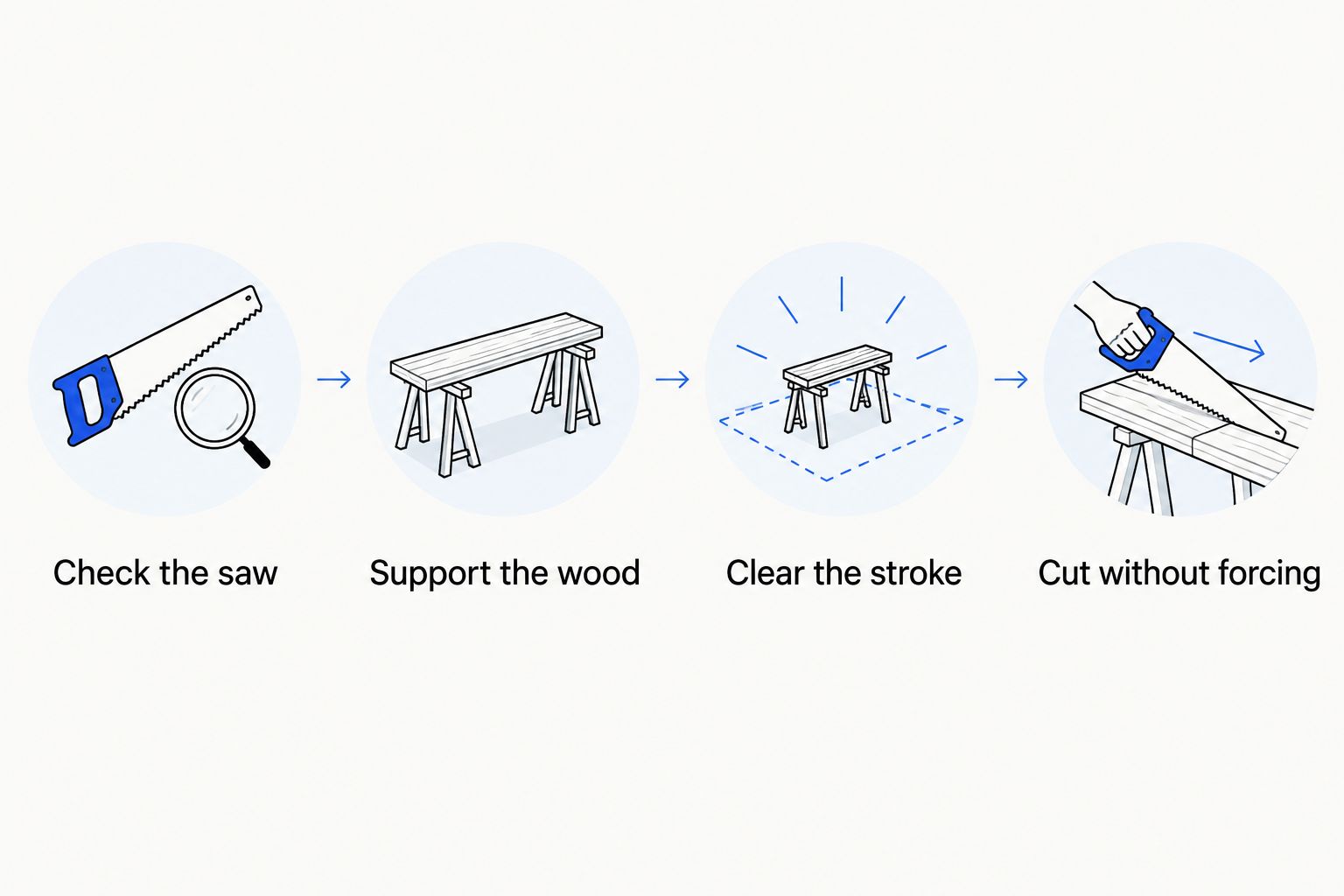
A saw cutting cleanly should not need you to steer it sideways through the kerf. If the blade is trapped, stop. Assess how the wood is supported and whether the cut is closing before continuing.
Use only wood you are permitted to collect and cut. Bushcraft does not override land-management rules, fire restrictions, or the risks posed by stressed and suspended wood.
Carry and maintain the saw as a cutting tool
Your 2026 kit should account for the saw when it is dirty as well as when it is clean. Teeth, sap, moisture, and pack contents are a poor combination. Close and store the tool according to its instructions, with the blade properly enclosed.
- After cutting: Remove debris using the manufacturer's recommended method. Do not run bare fingers along the teeth.
- Before storage: Clean and dry the tool as instructed. Check the pivot area and blade enclosure for trapped material.
- Before the next trip: Inspect the blade, handle, and locking mechanism. Resolve damage or uncertain lock operation before using the saw.
- Before replacing parts: Match the replacement to the exact model. A shared brand or family name is not a compatibility guarantee.
Keep cutting tools accessible without leaving exposed teeth loose in your pack. The best storage location is one that protects the tool and lets you retrieve it without dragging it across other equipment.
Do not improvise sharpening instructions for an unfamiliar tooth design. Check the manufacturer's guidance for the exact blade. Maintenance advice for a different saw is not automatically suitable for either Gomboy model.
FAQ
What's the best folding saw for general bushcraft in 2026?
The Gomboy Curve Pro 210mm is the default pick in this comparison. Choose the Gomboy Kuro instead when you specifically want its longer 240mm curved blade.
Is the Gomboy Kuro better than the Gomboy Curve Pro?
The Gomboy Kuro is the better fit for buyers who specifically want a longer blade. Its 240mm blade is 30mm longer than the Curve Pro 210mm, but the anniversary finish does not establish faster cutting.
Should I choose a 210mm or 240mm folding saw?
Choose the 210mm format when it fits your usual cutting tasks, and the 240mm format when additional blade travel serves a specific purpose. Check closed dimensions and weight separately because blade length does not establish carry size.
Does a curved folding saw blade matter?
Blade curvature is a cutting-related design feature, and both compared Gomboy descriptions identify curved blades. It does not remove the need for stable support, clear stroke space, and correct technique.
Can a folding saw replace my bushcraft knife?
A folding saw does not replace a knife for carving and trimming. It handles crosscutting wood, so the tools serve different jobs in a bushcraft kit.
What should I do if my folding saw gets stuck?
Stop cutting and assess the support and closing kerf rather than twisting the blade free. Keep your hands clear of the teeth while correcting the setup.
Does the Gomboy Kuro's Black Oxide finish mean I can skip maintenance?
The Black Oxide finish is not a reason to skip maintenance. Follow the exact model's cleaning, drying, inspection, and storage instructions.
One last thing
Before buying a longer saw, inspect the support you use for cutting. If the branch rolls, the kerf closes, or your stroke hits the ground, adding blade length does not fix the problem. Improve the setup first.
For your 2026 kit, buy the saw around your ordinary cutting task—not the largest piece of wood you can imagine tackling. The Curve Pro 210mm remains the default here. Move to the Kuro's 240mm blade when the extra working length has a defined job.
